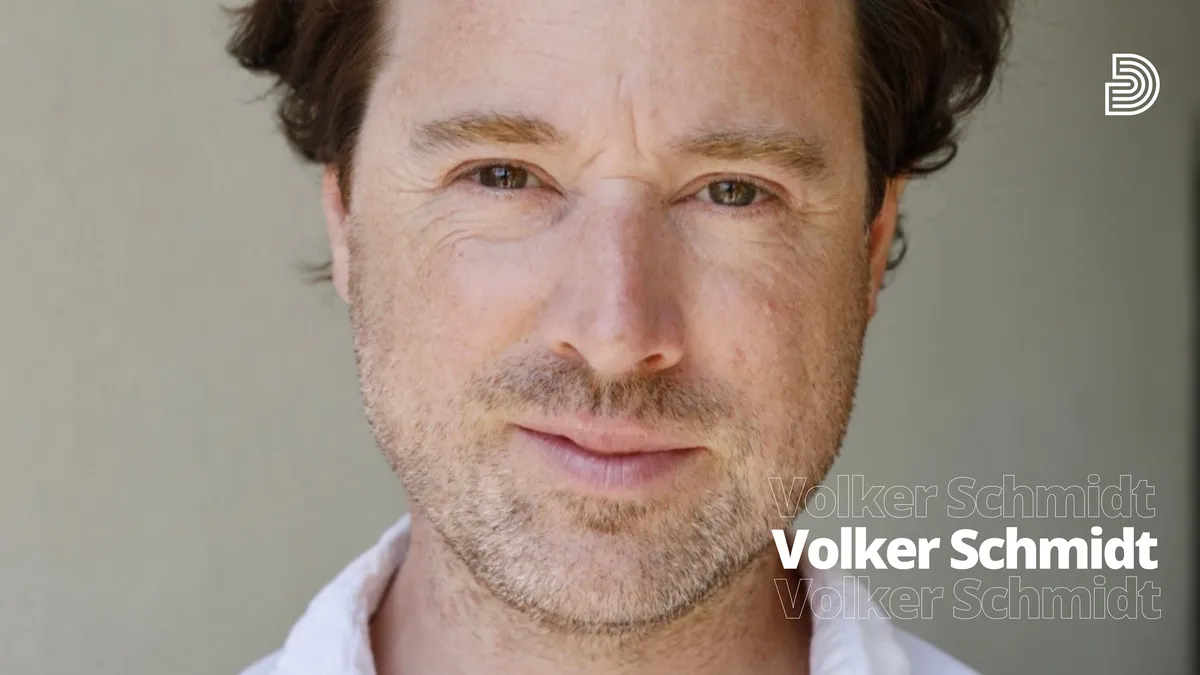
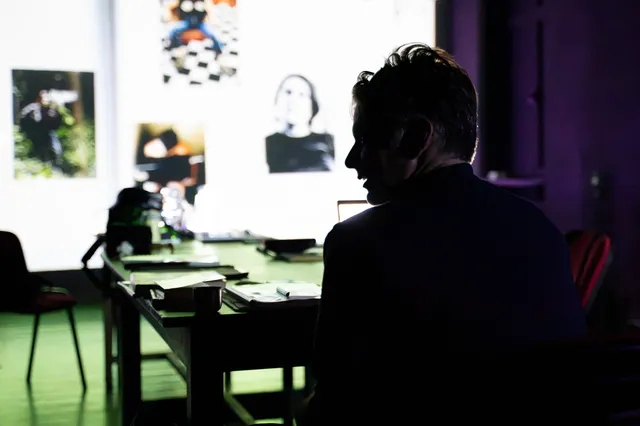
Volker Schmidt, born in
1976 in Klosterneuburg - Austria, is an author, actor and director currently
living in Vienna. Volker completed his acting studies at the Vienna
Conservatory in 1998. Volker Schmidt has directed productions at the Vienna
Festival, Staatstheater Hannover in Darmstadt, Schauspielhaus Vienna, Moscow
and Copenhagen. His first contact with the German State Theatre Timișoara took
place in 2011, when he arranged the staging of his play "The Mountainbikers",
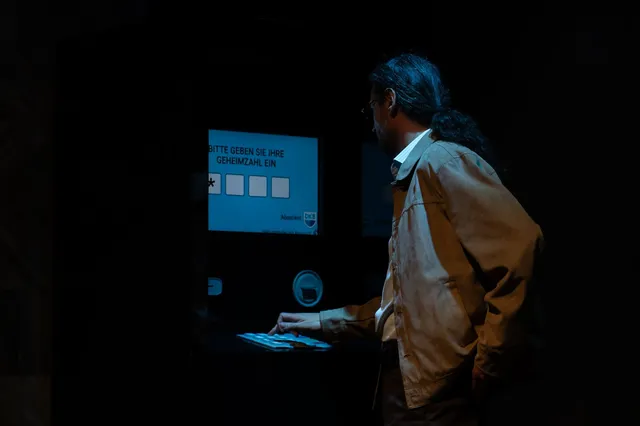
directed by Radu Nica. In 2015, he worked for the first time as director and set
designer at GSTT, where he staged his play “Actually it’s beautiful”. So far,
his plays have been translated into ten languages and performed in many
countries.
Andrea Wolfer:
What is it like for you to stage again at GSTT? How is the atmosphere in the theatre
in general?
Volker Schmidt:
Well, it's very familiar to be here again. This is my second time directing
here, but I have a longer history, with theatre, but also as an author. Today I
was also on stage, it's very, very productive, very, very collegial. Collegial
and pleasant working atmosphere.
Andrea Wolfer:
Why Chekhov? And why "The Cherry Orchard"?
Volker Schmidt:
Well, that was my personal wish. On the one hand, I think Chekhov is still very
valid, because he is able like nobody else to show people without condemning
them, in all their ambivalence. And he does it with comedy, but also with
tragedy. I think a tragicomedy is the best way to describe it. And this is also
something that always interests me. So, whether I'm working as an author or as a
director, I always find that the simultaneity of tragedy and comedy is the best
way to describe our lives. It is also an attitude towards life that I find most
interesting, because despite the weight, you can approach life with a certain
lightness, with a certain distance, where you don't forget the game either. And
it is precisely this comic quality that people have in their wandering, in
their worries, in their weight, that Chekhov captures very well. You can
somehow see yourself and, at the same time, laugh at yourself and your
difficult fate. And that, I think, is a very important element. I think today
we are in a period where a lot of crises or problems arise because people take
themselves very seriously in what they do and who they are and they are not
able to laugh at themselves, often they are not able to observe what they are
doing from a certain distance. Then, of course, they always need an enemy who
has a different opinion or is of a different nationality, or whatever, who is
to blame for the fact that they themselves do not have the size or strength
that they would have if it weren't for others. And I think the most important
thing these days is to learn not to take yourself too seriously. And this is
something that Chekhov can show very well.
Andrea Wolfer: You
slip into these different roles: director, author and set designer. How do you,
as a theatre person, but also personally, observe Chekhov's world in "The Cherry
Orchard"?
Volker Schmidt:
First and foremost, I always look at it from a certain point of view, maybe
from a political point of view, and I wonder: What is the relevance for
society? Of course, there are artistic aspects that I find very interesting and
challenging or even exciting. But for me, of course, this social relevance is
of superficial importance. Then, in terms of the artistic aspect, I think there
is a certain love for a kind of nostalgia or the fact that we are always
dealing with a past that we still carry with us. And this is also the case with
Livia, where there is a past that has not been resolved and that still
manifests itself. And this is, of course, very interesting for me, as a set
designer, to bring these different layers of the past on stage. How they affect
the space, but also the people. And that starts with the space, of course, all
the way through to the costumes, props and so on. And simply depicting these
different layers of the times and then saying: "Okay, what can the new,
the future, grow out of?
Andrea Wolfer:
And how does your directorial concept work with the various actors in the
ensemble? How does the rehearsal process go?
Volker Schmidt:
Well, we are making very good progress. Because we only have six weeks of
rehearsals, we asked the actors to learn the text beforehand. Reading the text
is something completely different from seeing it on stage. You must look at who
is on stage at the moment, what is being negotiated, where and with whom. It is
quite a large staff, 12 people constantly appearing and disappearing. As for
me, I've always found that I try to prepare, but it's really only on stage that
I'm able to formulate thoughts about how I want to achieve them, in working
with the actors. And that is good because they already know me. And then, of
course, there is also trust and patience in doing this together. And we're
actually making very, very rapid progress as a result. And I think it's even
better than if we had first dismantled everything in theory.
Andrea Wolfer:
Yes, that's exactly what I was going to ask you, if the fact that you already
know each other to some extent helps the rehearsal process. So you and part of
the ensemble, you with the set designer Ioana Popescu. What's it like to work
together again with a partly familiar ensemble and a familiar ensemble?
Volker Schmidt:
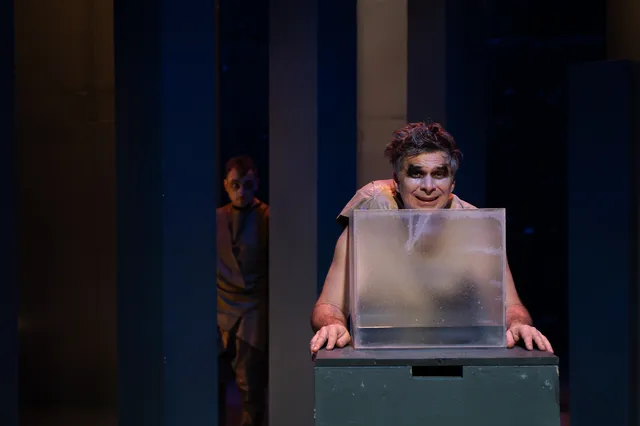
Yes, Ioana Popescu is also in charge of costumes and supports me on stage. And
this is always, always completely different when you already know the artists
involved. You can just start from somewhere else and, as you say, you already
know a lot of the band members. Some of the actors have joined, they're new to
the whole thing. They're newcomers who fit in very well with the group and I
think it's a very familiar ensemble. And that's why you're part of the family
too. And sometimes - you have to prove it to yourself, but you don't always
have to - you can be lost, you can look for a solution together. I think this
leads to a different outcome than if you don't know people at all.
Andrea Wolfer: You
also mentioned the clash of worlds. What can the audience imagine - without us
telling them important information about the production shortly before the
premiere - what should the general public expect?
Volker Schmidt:
Well, the play doesn't necessarily have to be located in Russia. Of course,
there are references that interest me, which in this case are also references
to Romania. And I think this is true for many countries in the East, because
many young people have gone to the West to try a new life there. And we decided
very soon to move from Paris, where Ranevskaya disappeared with her friends and
her then partner or husband, to Berlin, because it was the capital of the new
millennium, where everybody went and tried their luck. I'm trying to bring a
bit of that party scene from there, including in costume. And just this return,
when people come back from there and notice that everything is different here.
And I think that's something that affects a lot of people, that maybe a lot of
people know. On the other hand, it applies to this moving away from home. And
then you go back home and maybe you go back to a house that's been there from
another time. When you say, well, they've been gone for a few years and you
can't live there anymore. There are other laws that prevail. And that's one of
the things I try to let flow and at the same time show a generation that was
just very apolitical. I'm talking about my own generation. And this is a very
important theme for me, because Ranevskaya is actually my age.
In the 1990s and 2000s I
thought: yes, this is the end of history. In fact, there was nothing left to do
and we were very apolitical. We just turned around and looked at where we were.
And it was a very hedonistic era and also with lots of drugs, etc., and
self-awareness and yoga, blah, blah, etc. And yes, now we have a completely
different young generation, which is very political, which is facing humanity's
biggest catastrophe, the climate crisis. And then the other crises came along.
There's been a crazy change, and this is reflected quite well in the play.
Because there is the character of Trofimov, who talks about everything that
needs to be done, what needs to be done, what doesn't fit in our world, but he
himself still fails to make a step. So I would rate him somewhere between those
two generations. And that's another thing that plays an important role. Then
there is also the fact that there has simply been a very different way of
approaching gender, that there has simply been a great development, that there
is an opening, that different genders have reached the middle of our society,
so to speak. But when you get to the rural environment, so to speak, then it
is, of course, very different from the urban environment and the way it meets
here. This self-image of urban people in relation to what simply doesn't exist
in the countryside.
Andre Wolfer:
You're tackling politics, gender norms. But you also reference money and the
importance of money in this show. Can you tell us a bit about the role of money
in "The Cherry Orchard"?
Volker Schmidt:
Yes, actually, in "The Cherry Orchard" it's almost always all about
money. It's all about money all the time. And, of course, this also has to do
with the fact that they don't exist. And some say: I don't need it and I don't
have it, and others: I need it and I don't have it. The other says: I have it
and I want to have more. There is a certain difficulty that arises in relation
to them and this is something we experience all the time. And I think money
always plays a role in an environment where inequality prevails. And what's
interesting in "The Cherry Orchard" is that this inequality is
reversed because Lopachin, who was originally the son of a farmer and ended up
raising himself, now has a lot more money than he had before. I don't think
that's the reality anymore. We already see that people who have a lot of money
are getting richer, and people who have little money are getting poorer. So
this is becoming more and more difficult.
This was an idea that
worked in the West, starting in the 1950s, where people were able to build
prosperity out of nothing. And maybe that worked until the 1990s. And today
every young person knows that it no longer works. Either you inherit and have
money, climbing the ladder doesn't really work anymore. So, you're either born
rich, so to speak, or you're not rich. And this has already changed a little.
But we also know that in times of crisis, everyone talks about money. Here
comes another grant and here comes another grant. And so on and so forth. And
this started with the pandemic and continues now. And, of course, we are
becoming more and more dependent, instead of simply trying to become as
independent as possible from monetary cycles and producing and managing in such
a way that we also create smaller economic cycles so that we are not too
dependent on the big monetary cycle.
Andrea Wolfer: Yes,
exactly. I think what you've explained so far about your directorial concept,
and in general your concept and vision as a theatre person, but also as an
individual, seems to come together in a very dynamic show. What are the
highlights? Do you have a favourite scene right now? What are the scene when
you say to yourself, "Yes, this is something that needs to be seen."
And yes, that's the scene that the audience should come for, because they're
going to have that experience.
Volker Schmidt:
Oh, I find it quite difficult to talk about these scene, I prefer to let the
audience discover their own favourite moments, because I try to distribute them
so that there is always something. But what I'm interested in is simply
creating an atmosphere. Which works well with Chekhov, of course. He's already
a very atmospheric author, but he can create a wide range of dynamics, as you
said, but also empty spaces. I find dynamics very interesting or important,
because comedy itself always has a high dynamic. And Chekhov is known more as
an author who is often portrayed as very slow and lethargic. And it is
precisely this conflict that is interesting. I think the audience will have a
lot of fun. It's going to be a funny evening at times, and at times the
audience will be spoiled with certain images. And maybe they'll get a moment or
two of spectacle. I think that's what I can reveal to you now.