LAIOS
Direction: Alexandru Mihăescu
With: Yannick Becker, Ioana Iacob, Marc Illich, Ida Jarcsek-Gaza, Alexandru Mihăescu, Simona Vintilă, Radu Vulpe, Robert Bogdanov-Schein.
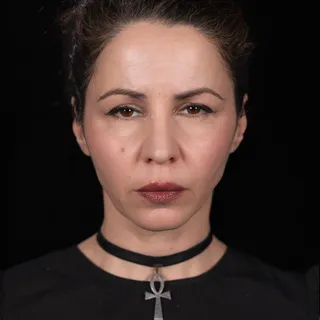
After a long period of political instability and bloody coups, Thebes needs a leader. They will bring Laius, the last in the line of Cadmus, the founder of the city, to the throne, believing that in this way they are making a choice that is in accordance with tradition, a safe choice that will calm spirits and bring stability. However, Laius is the most unsuitable person for this role: self-centered and eccentric, himself the victim of a bloody childhood in Thebes, he is sent into exile at a young age, where he kidnaps the young Cryssipus from his adoptive family to run away with him into the world. Having come to rule Thebes without really wanting to, he neglects his duties and becomes obsessed with the oracle that forbids him to have a child with Jocasta. Together they will defy the gods because Jocasta, a wonderful queen, much more suited than Laius to bring stability (but who can see that?), is also a tragic character who bears some of the blame: she cannot conceive of a life other than the one prescribed for her by Theban society. Her mission, in other words, is to bring a child into the world, and she will fulfill it at any cost. Roland Schimmelpfennig's polymorphic text seems intended to fill this biographical gap and invites us into a playful space to solve a riddle like the one given by the Sphinx, in which the actors articulate the myth of a fictional Laius together with the audience. It is a game that can shift, sometimes surprisingly, from a serious and tragic tone to a countercultural or trash punk discourse, but the stakes remain in the characters' search—Laius, Jocasta, the kidnapped young Cryssipus—for a possible balance between individual freedom and responsibility to the group. Ignoring the oracle would have clearly defined consequences for the polis, and the second part of the show is a gallery of failures in which the characters explore four different scenarios, none of which prove acceptable. Putting this puzzle together subversively reveals ideas and attitudes that we recognize and that, in the context of our current needs for freedom, belonging, security, and equal rights, actually reflect the tragic conflict between rapid progressivism and conservatism, so acute in today's society.
LIEBE / LOVE
Direction: Irisz Kovacs
With: Isa Berger, Enikő Blénessy, Daniel Ghidel, Aida Olaru, Alma Diaconu/ Silvia Török
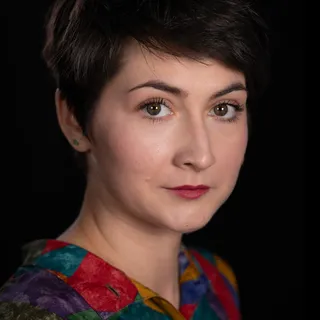
Recently settled in Germany, the writer Olivia and the ever-in-the-making director Popeye meet at a German language course and begin what seems to be a fairly ordinary love affair. Despite the language barrier and the ten-year age difference between them—he being the younger one—the lovers go on dates, move in together, and build a life side by side. However, in their seemingly uncomplicated and conventional story, problems begin to surface—problems that only one of them appears to notice. LOVE / An Argumentative Exercise invites us to peer almost secretly, as if through a window, into the couple’s life of Olivia and Popeye, characters shaped after the beloved animated archetypes. Through an ironic analysis of patriarchal structures, the status of the artist, and a deep dive into Olivia’s inner world, playwright Sivan Ben Yishai’s text explores how people who appear rationally aware of these social structures can nonetheless fall, in their personal lives, into the very patterns they publicly criticize.
DOSENFLEISCH / CANNED MEAT
Direction: Clemens Bechtel
With: Tatiana Sessler-Toami, Olga Török, Franz Kattesch, Richard Hladik
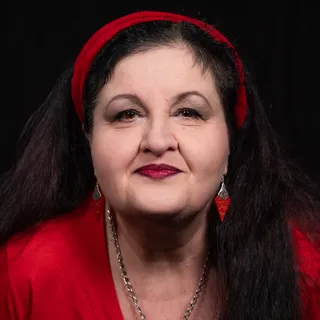
One evening, Rolf, a motor insurance inspector, stops at a gas station on the side of the highway. From there, he can observe the stretch of road where an unusually high number of accidents have been occurring lately. To his dismay, the nosy gas station clerk, Beate, keeps approaching him, rambling on with bizarre remarks.Trying to avoid her, he meets Jayne, an actress wandering through the same rest stop. Fascinated by her, Rolf cannot shake the feeling that he knows her from somewhere. As he struggles to sort out his thoughts, strange things begin to happen at the station, and the atmosphere grows increasingly ominous. dosenfleisch is Ferdinand Schmalz’s second play and was invited to the Mülheim Theatre Days in 2016. It is an unconventional detective story in which the playwright tackles themes such as the ecological and social impact of infrastructure development and the impersonal relationships between people in a perpetually hurried world. These themes are explored both in the characters’ reflective monologues and in the epic passages of the long-haul truck driver, the character who partially narrates the action.
DIE POLITIKER / THE POLITICIANS
Collective Direction
With: Isolde Cobeț, Alma Diaconu, Boris Gaza, Rareș Hontzu, Bülent Özdil, Daniela Török, Oana Vidoni, Harald Weisz
In this text, which resists classification within a single literary genre—hovering at the boundary between the lyrical and the dramatic—Wolfram Lotz deconstructs the term “politicians” through exaggerated repetition, pushing it to a level of comic and even irritating absurdity. The work is based on a long-term project of the author, who in 2018 set out to write a “total diary” that would document his life continuously and in detail. A year later, overwhelmed by doubts about the justification of publishing such deeply personal scenes, he deleted the document and, in 2022, wrote the novel Holy Scripture I, drawing on that diary. The Politicians, however, became a dramatic poem in which Lotz combines philosophical reflections, metaliterary passages, and jokes in a playful poetic form.
GERMAN SONG NIGHT
With: Dana Borteanu, Roxana Ardeleanu
*
The Drama Nights project takes place outdoors, so in case of rain or unfavorable weather, the following rules apply: if it starts raining before the scheduled performance time, the show will be rescheduled and tickets will remain valid, with spectators having the option to request a refund or exchange their tickets for another performance from the German State Theatre’s program; if it starts raining during the performance, the show will be interrupted and will resume once the rain stops, and if resuming is not possible and the show is suspended, it will not be rescheduled and ticket costs will not be refunded.